
If you are perusing through some DevOps articles or documentation, chances are you might have encountered the acronym CIDR, but what the heck is it? and why is it a fundamental concept in modern-day networking?
An IP address consists of a network address and a host address. Before CIDR existed, IP address allocation was based on a classful system1 such as Class A (8 network prefix bits), Class B (16 network prefix bits), and Class C (24 network prefix bits).
The fixed nature of the classful system led to IP address waste. For example, for a network with 500 devices, a Class C IP address would only cover up to 256 (2^8), which meant that an upgrade to Class B would be the next move. However, this led to the waste of 65,036 IP addresses, as only 500 were needed. Wouldn’t it be nice in this case to provision fewer IP addresses to reduce the waste?
Enter the Classless Inter Domain Routing, or CIDR for short. The CIDR represents a contiguous block of IP addresses, and has the format of an IP Address followed by a suffix number like so.
  block
columns 1
  cidr["CIDR Example (256 IP Addresses)<br> 192.168.1.0/24"]
  block:CIDRparts
        network["Network bits<br>192.168.1"]
        host["Host bits<br>0"]
        suffix["Suffix Number<br> /24"]
  end

  block:CIDRSubnet
    derive["Derive Network identifier bits"]
    derive:1
    space
    subnet["Subnet Mask <br> 255.255.255.0"]
    subnet:1
  end
  suffix --- subnet
  subnet --- derive
  derive --> network
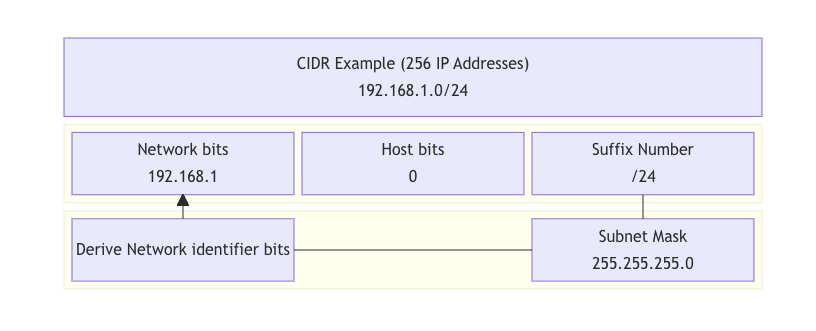
The key here is the suffix number, which corresponds to the prefix length of the network portion of the address. Internally, a subnet mask is applied to return the value of the network address by turning the host address bits into zeroes. In the above example, we have 24 bits for the network identifier, and the remaining 8 bits for the host identifier which results in 256 total IP addresses. If we wanted to have more IP addresses, we would decrement the suffix number.
  block
columns 1
  cidr["CIDR Example (16,777,216 IP Addresses)<br> 192.168.1.0/12"]
  block:CIDRparts
        network["Network bits<br>192"]
        host["Host bits<br>168.1.0"]
        suffix["Suffix Number<br> /8"]
  end

  block:CIDRSubnet
    derive["Derive Network identifier bits"]
    derive:1
    space
    subnet["Subnet Mask <br> 255.0.0.0"]
    subnet:1
  end
  suffix --- subnet
  subnet --- derive
  derive --> network
In contrast, if we define 8 bits for the network portion of the address, we have 24 bits that are variable for host addresses, resulting in (2^24) or 16,777,216 available IPs, that’s a lot! Similarly if we wanted less we just have to adjust the notation of the CIDR suffix to be larger.
Thanks to CIDR, IP address allocation is efficient, reducing routing table size which allows routers to forward packets more effectively. Its use extends into the cloud native ecosystem with projects like Kubernetes relying on CIDR to allocate IP addresses for internal networking. In Kubernetes, each node in the cluster gets assigned a Pod CIDR, from which an individual pod on that node gets its own IP address. Similarly, a Service CIDR across the cluster is used to assign internal IPs to services, enabling pods to discover and communicate with each other.
Did you know about CIDR?
Resources: